Please note that the trial has now closed.
The PIROUETTE trial included patients with heart failure with normal forward pumping function of the heart (‘heart failure with preserved ejection fraction’, or ‘HFpEF’ for short), and heart muscle scarring (fibrosis).
Patients underwent a heart MRI scan at the beginning of the study. Patients with evidence of heart muscle scarring, as indicated by a heart MRI measurement called ‘extracellular volume’, were randomly assigned to take pirfenidone or a placebo daily for 1 year. 94 patients were randomised: 47 took pirfenidone and 47 took placebo. After a year, patients underwent a second heart MRI scan to measure the change in heart muscle scarring.
The results showed that pirfenidone reduced heart muscle scarring. Extracellular volume declined by 1.21% more on average in patients who took pirfenidone compared with those receiving placebo.
Fluid retention, measured using a blood test called NT-proBNP, also improved in patients taking pirfenidone compared to those receiving placebo. There were no differences in measurements of heart muscle relaxation.
The most common side effects in patients taking pirfenidone were nausea, insomnia and rash, which are similar to those which lung patients can experience when taking pirfenidone.
The findings suggest that pirfenidone could have favourable effects in patients with HFpEF. Larger trials are now needed to determine whether pirfenidone improves the expected course of HFpEF (prognosis), for example, whether it reduces admissions to hospital for heart failure and heart failure-related deaths.
If you would like to read more about the results, please go to https://www.nature.com/articles/s41591-021-01452-0
The study team would like to thank the patients who took part in PIROUETTE, and their families and carers, and the patients who were part of the study oversight committees. The study was only possible with your help and support.
PIROUETTE - A double-blind randomised controlled trial of Pirfenidone in patients with heart failure and preserved ejection fraction
This clinical trial has been designed to test whether a drug called pirfenidone leads to a reduction in heart muscle scarring and improves heart function in patients with heart failure.
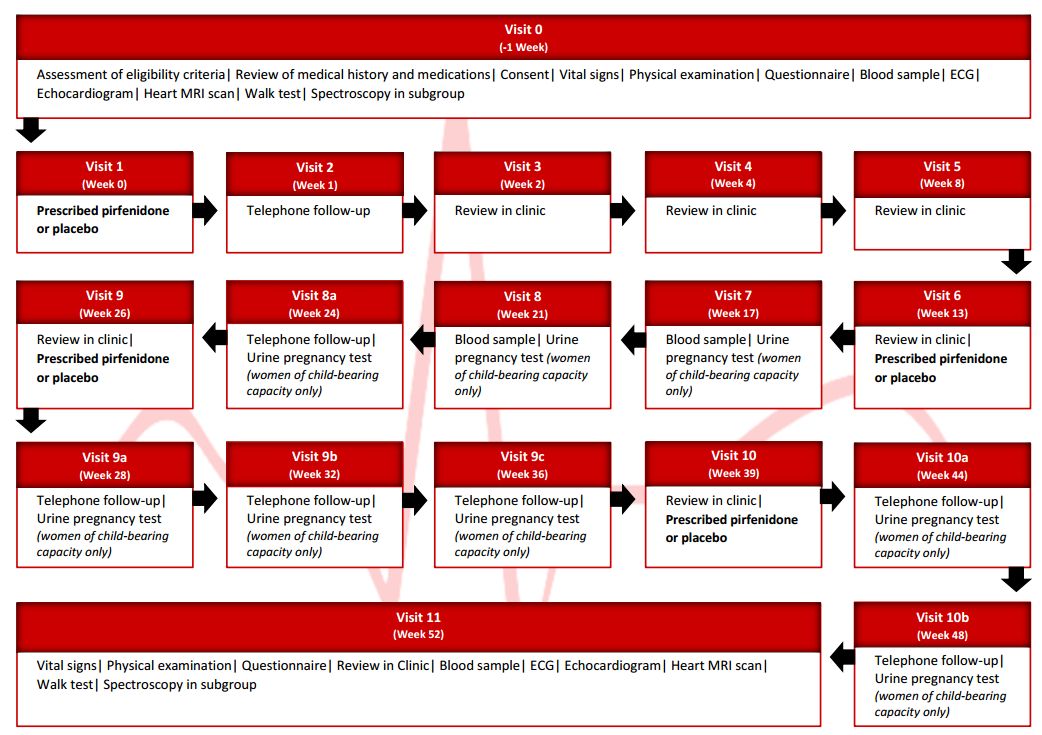
Taking part involves 11 visits to the hospital and 1 telephone call, additional telephone calls will apply to women of childbearing potential to assess home pregnancy testing.
Study tests include: spectroscopy, blood tests, heart trace (ECG), echo (ultrasound scan of your heart), heart magnetic resonance imaging (MRI scan of your heart), short questionnaire, walk test, and pregnancy test if you are female and of childbearing age.
The study will take part in Cardiac Departments across the country. To see if your hospital is taking part in this study please go to recruiting centres.
This study has been funded by the National Institute for Health Research.
The University Hospital of South Manchester NHS Foundation Trust
’The study has been reviewed by a research ethics committee, who have agreed the study is being conducted in a correct and appropriate manner. The study has also been approved by the Medicines & Healthcare products Regulatory Agency (MHRA) and the Health Research Authority (HRA).
You have been invited to take part because you have heart failure with preserved ejection fraction.
You do not have to take part if you do not wish to and your decision will not affect any standard of care you receive.
It is okay if you agree to take part in the study but later change your mind. You do not need to give a reason. The study doctor may also choose to withdraw you if it is necessary for your health. If you decide that you would like to withdraw from the study before the final visit all information collected up until the time of withdrawal will be included in the study analysis, unless you request that it is removed. If you do withdraw we advise that you attend the follow-up visit so that we can make sure that you are still well.
Heart failure with normal heart pumping function (so called “preserved ejection fraction”) is very common. However, there is no treatment that leads to an improvement in quality of life or life expectancy.
Heart muscle scarring (fibrosis) is an important process in the development of heart failure with preserved ejection fraction. We want to find out if a medicine called pirfenidone leads to a reduction in heart muscle scarring and improves heart function. Ultimately we want to find out if pirfenidone leads to improved quality of life and life expectancy of patients with heart failure.
Pirfenidone is currently used in patients with lung scarring. In patients with lung scarring, pirfenidone leads to a reduction in the amount of lung scarring. This leads to improved lung function, improved exercise capacity (i.e. patients can walk further before they have to stop) and improved life expectancy (i.e. patients live longer). We want to find out if pirfenidone has the same effects in patients with scarring and heart failure as it does in patients with lung scarring.
The study will last for 1 year. We will keep a close eye on you during the study. We will phone you 1 week after starting the medication and see you in clinic, take a blood sample and do an ECG at approximately 2, 4, 8, 13, 17, 21, 26 and 39 weeks after you begin the study. After 1 year we will repeat the echo scan, the heart MRI scan (if you had 2 MRI scans at the start of the study, you will have 2 at the end), the questionnaire and the walk test. In total you will have 1 telephone call and 11 clinic visits during the study. Women of childbearing potential will also receive additional telephone calls at 24, 28, 32, 36, 44 & 48 weeks to assess home pregnancy testing.
The clinic visits will be at Wythenshawe Hospital. Travel costs will be reimbursed.
If the results of the initial tests show that you are not eligible to take part in the trial we will record your results and use them to improve the medical community’s understanding of heart failure.
Manchester University NHS Foundation Trust (MFT) and the University of Liverpool Clinical Trials Research Centre (CTRC) take great care to abide by our legal and moral obligations when handling your personal and healthcare data. Due to changes introduced in the EU General Data Protection Regulation (GDPR), we would like to provide you with information on the lawful basis on which we are processing your data. The lawful basis for the processing of your personal data for the research study which you have participated in is a “task in the public interest”.
As a university and NHS organisation, the University of Liverpool Clinical Trials Research Centre (CTRC) and Manchester University NHS Foundation Trust (MFT) use personally-identifiable information to conduct research to improve health, care and services. As a publicly-funded organisations, we have to ensure that it is in the public interest when we use personally-identifiable information from people who have agreed to take part in research. This means that when you agree to take part in a research study, we will use your data in the ways needed to conduct and analyse the research study. Your rights to access, change or move your information are limited, as we need to manage your information in specific ways in order for the research to be reliable and accurate. If you withdraw from the study, we will keep the information about you that we have already obtained. To safeguard your rights, we will use the minimum personally-identifiable information possible.
Health and care research should serve the public interest, which means that we have to demonstrate that our research serves the interests of society as a whole. We do this by following the UK Policy Framework for Health and Social Care Research.
If you wish to raise a complaint on how we have handled your personal data, you can contact our Data Protection Officer who will investigate the matter. If you are not satisfied with our response or believe we are processing your personal data in a way that is not lawful you can complain to the Information Commissioner’s Office (ICO).
Our Data Protection Officer is Victoria Heath and you can contact them at LegalServices@liverpool.ac.uk .
Our Data Protection Officer is MFT Data Protection Officer and you can contact them at dpo@mft.nhs.uk or alternatively, information.governance@mft.nhs.uk.
When you agree to take part in a research study, the information about your health and care may be provided to researchers running other research studies in this organisation and in other organisations. These organisations may be universities, NHS organisations or companies involved in health and care research in this country or abroad. Your information will only be used by organisations and researchers to conduct research in accordance with the UK Policy Framework for Health and Social Care Research.
This information will not identify you and will not be combined with other information in a way that could identify you. The information will only be used for the purpose of health and care research, and cannot be used to contact you or to affect your care. It will not be used to make decisions about future services available to you, such as insurance.
If you have not already been provided with an information leaflet detailing the GDPR changes, please find this here .
The following 1 sites are participating
1 Wythenshawe HospitalThe following 5 Participant Identification Centres are taking part
1 Manchester Royal InfirmaryPlease feel free to contact the PIROUETTE study team by any of the means below: